
You didn’t spend years mastering the musculoskeletal system just to stare at an empty appointment book.
In a world where patients are one “physio near me” search away from your competitors, being a great clinician isn’t enough — you have to be the most visible one. A powerhouse physiotherapy marketing strategy does more than fill appointment slots; it builds a brand patients trust before they even walk through your door.
This guide covers everything from SEO-driven websites to community workshops, so you can stop being your town’s best-kept secret and start becoming its go-to practice.
Understanding Your Target Audience
Before you spend a single dollar on marketing, you need to know exactly who you’re trying to reach. Physiotherapy serves a wide range of patients — and the more precisely you define your audience, the more effectively (and cheaply) you can market to them.
Want a free website & marketing audit?
We’ll show you what’s working, what isn’t, and give you a roadmap for clinic growth. Completely free, no obligation whatsoever.

Define Your Core Patient Segments
Start by identifying which patient groups you can serve best. Common segments include:
- Athletes and sports enthusiasts recovering from acute injuries
- Post-surgical patients needing structured rehabilitation
- Office workers dealing with chronic neck, back, or wrist pain
- Seniors seeking to maintain mobility and prevent falls
- Expectant and postpartum mothers needing pelvic floor physiotherapy
- Children and adolescents with developmental or sports-related conditions
Trying to speak to everyone means speaking to no one. Pick one or two primary segments to anchor your marketing message, especially when starting out.
Go Beyond Demographics
Demographics — age, gender, location, income, occupation — tell you who your patients are. But psychographics tell you why they’ll choose you.
Ask yourself:
- What does my ideal patient most fear? (Chronic pain, losing their independence, not returning to sport?)
- What outcome are they really buying? (Getting back on the pitch, playing with their grandchildren, sleeping through the night?)
- Where do they search for health information? (Google, Facebook groups, word of mouth?)
- What makes them hesitate to book? (Cost, time, scepticism about physiotherapy?)
Understanding these motivations lets you write website copy, social media posts, and ad headlines that stop your ideal patient mid-scroll and make them feel understood.
Create a Patient Persona
Consolidate your research into a one-page patient persona. Give them a name, a problem, a goal, and a decision-making style. Every piece of marketing content you create should speak directly to that person.
Get The Ultimate PT Clinic Marketing Handbook
It’s packed with tips and strategies you can use to grow your clinic today.
Building a Strong Physiotherapy Brand
Your brand is the sum of every impression a patient has of your practice — from your Google listing thumbnail to the way your receptionist answers the phone.
Define Your Unique Selling Proposition (USP)
Your USP is the specific reason a patient should choose you over every other physiotherapist in town. It should be:
- Specific — “We specialise in getting runners back to training within 6 weeks” beats “We offer high-quality care.”
- Patient-focused — frame it as a benefit to them, not a credential for you.
- Defensible — something you can genuinely deliver, every time.
Questions to help uncover your USP:
- Do you hold specialist certifications or training (e.g., dry needling, pelvic health, concussion management)?
- Do you offer a service model competitors don’t (same-day appointments, home visits, online physiotherapy)?
- Do you serve a niche that’s underserved locally?
Once defined, your USP should appear on your homepage, in your Google Business Profile description, and in every ad you run.
Visual Identity and Branding Consistency
A professional, consistent visual identity builds recognition and trust. It should include:
- Logo — invest in a professional designer; avoid free online generators
- Colour palette — choose 2–3 colours that convey your brand personality (calming blues, energetic greens, clinical whites)
- Typography — select readable fonts used consistently across all platforms
- Tone of voice — decide whether your brand is warm and conversational, clinical and authoritative, or somewhere in between
Apply this identity consistently across your website, social media, printed materials, signage, and email signatures. Inconsistent branding erodes trust.
Branded Touchpoints Worth Investing In
- Business cards with name, title, phone, email, and website
- Clinic signage — clear, visible, and professionally printed
- Patient-facing collateral — exercise prescription pads, brochures, appointment cards
- Branded giveaways — resistance bands, foam rollers, or ice/heat packs with your logo are both practical and memorable
RELATED READING: 20 Physical Therapy Marketing Ideas That Actually Work in 2026 (Ranked by ROI)
7 Tips for Building a High-Converting Physiotherapy Website
Your website is your most powerful marketing asset. It works 24/7, speaks to patients at the exact moment they’re searching for help, and is often the deciding factor between a booking and a bounce.
Here are 7 tips every great physio website must have.
1. Clear, benefit-led messaging above the fold Your homepage headline should tell visitors immediately who you help and how. “Helping desk workers eliminate back pain without surgery or medication” is more compelling than “Welcome to [Clinic Name] Physiotherapy.”
2. Online booking Patients increasingly expect to book online, especially outside business hours. A friction-free booking system — directly integrated into your site — removes the single biggest barrier between interest and appointment.
3. Social proof Include patient testimonials throughout the site (especially on service pages), display your Google rating, and link to your Google reviews. For high-stakes treatments, before-and-after case studies can be particularly persuasive.
4. Service pages optimised for search Create individual pages for each core service (e.g., “Sports Injury Physiotherapy,” “Post-Surgical Rehabilitation,” “Dry Needling”). These pages are the workhorses of your SEO strategy.
5. A compelling “About” page Patients choose physiotherapists they trust. Use the About page to introduce your team, share your qualifications, and tell the story of why you do what you do.
6. Mobile-first design More than 60% of healthcare searches happen on mobile. Your site must be fast, readable, and bookable on a smartphone.
7. Fast load speed Google penalises slow sites in rankings, and users abandon pages that take more than 3 seconds to load. Compress images, use a reliable host, and regularly audit your page speed.
Common Website Mistakes to Avoid
- Using stock photos of generic healthcare settings (use real photos of your clinic and team)
- Burying the phone number and booking button
- No clear call-to-action on every page
- Outdated content or broken links
Read the full list of physiotherapy website design mistakes.
Local SEO for Physiotherapy Clinics
For most physiotherapy practices, local SEO is the highest-ROI marketing activity you can invest in. When someone searches “physiotherapist near me” or “physio [your suburb],” you want to be in the top three results.
Some of our clients have increased their new patients by over 300% by ranking better for their most important keywords.
Get a free website and SEO audit
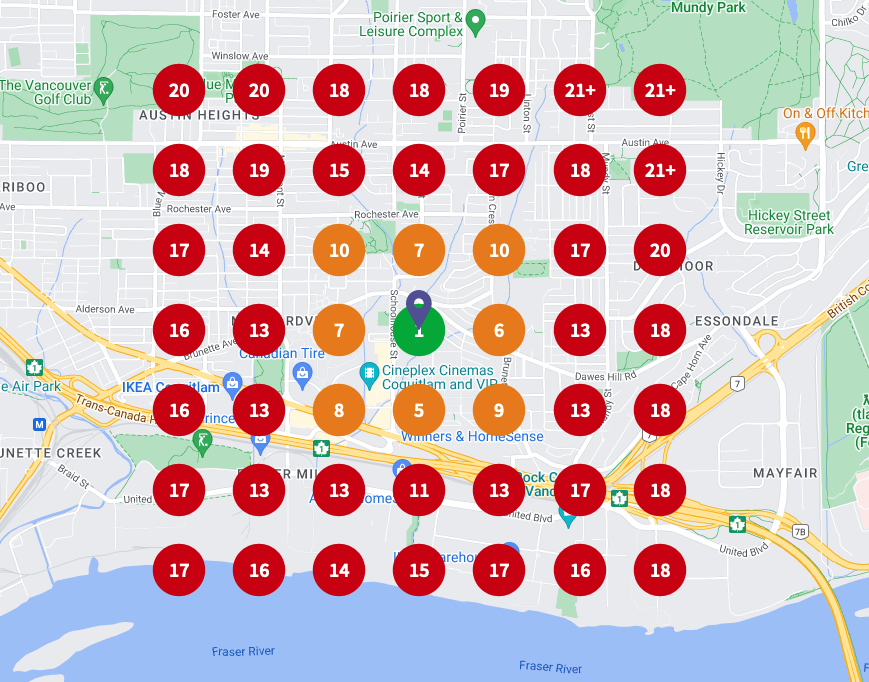
Optimize Your Google Business Profile
Your Google Business Profile (formerly Google My Business) is the most important local SEO asset you have. To maximise it:
- Claim and verify your listing if you haven’t already
- Complete every field — name, address, phone number, website, hours, services, photos
- Choose the right primary category (“Physiotherapist” — not a generic health category)
- Add photos regularly — clinics with photos receive significantly more clicks
- Collect and respond to reviews — quantity, recency, and responses all influence your local ranking
- Post weekly updates — Google Posts (tips, offers, new services) signal an active business
On-Page Local SEO
For your website to rank locally:
- Include your city/suburb in page titles, headings, and body copy naturally (e.g., “Physiotherapy in Saanich, BC”)
- Embed a Google Map on your Contact page
- Ensure your Name, Address, and Phone (NAP) is identical everywhere it appears online
- Add LocalBusiness schema markup to your homepage
Build Local Citations
List your practice in relevant online directories with consistent NAP information:
- Google Business Profile
- Bing Places
- Healthgrades, RateMDs, or equivalent local health directories
- Yellow Pages / local business directories
- Your professional association’s find-a-physio directory (e.g., the Canadian Physiotherapy Association)
Earn Local Backlinks
Links from other locally relevant websites boost your local authority. Target:
- Local newspapers and community blogs (offer to write a column or be quoted as an expert)
- Local sports clubs and gyms (sponsor or partner with them)
- Complementary health practitioners (exchange links with GPs, chiropractors, massage therapists)
- Local business associations and chambers of commerce
Keyword Strategy for Physiotherapy SEO
Target a mix of:
| Keyword Type | Example | Intent |
|---|---|---|
| Branded | “[Clinic Name] physiotherapy” | High-intent; protect your brand |
| Service + Location | “sports physio Victoria BC” | Booking-ready |
| Condition + Location | “back pain physiotherapist Saanich” | Problem-aware |
| Informational | “how long does physio take for rotator cuff” | Research phase; blog content |
Create a blog that answers the questions your ideal patients are Googling. Each well-optimised post is a permanent traffic asset that compounds over time.
Social Media Marketing for Physiotherapists
Social media won’t fill your appointment book overnight, but it builds the awareness and trust that makes every other marketing channel more effective.
Choose the Right Platforms
Don’t try to be everywhere. Prioritise based on where your target audience actually spends time:
- Facebook — ideal for reaching adults 35+, running local targeted ads, and building community
- Instagram — strong for visual content, reaching active/sports-oriented demographics, and short-form video
- LinkedIn — valuable if you work with corporate wellness, GPs, or other referrers
- TikTok / YouTube — high-effort but high-reach for educational video content
Content Ideas That Build Trust and Authority
The most effective physiotherapy social content:
- Quick exercise demos — “3 stretches for desk workers” outperforms generic clinic photos
- Patient success stories (with permission) — outcomes resonate far more than credentials
- Myth-busting posts — “You don’t have to live with chronic back pain” challenges common misconceptions
- Behind-the-scenes content — introduce your team, show your equipment, humanise your practice
- FAQs — address the questions hesitant patients are too nervous to ask
- Seasonal/topical content — injury prevention tips around ski season, gardening season, school sports season
Social Media Consistency
Posting once a month won’t move the needle. Aim for:
- 3–5 posts per week on your primary platform
- At least one short-form video per week (Reels, TikTok, or YouTube Shorts)
- Prompt responses to every comment and DM (within 24 hours)
Use a scheduling tool like Buffer or Meta Business Suite to batch-create content and maintain consistency.
Facebook and Instagram Advertising
Paid social advertising is particularly cost-effective for physiotherapy because you can target by location, age, and interest (e.g., running, gym-goers, seniors) with a relatively small budget.
Effective campaign types for physio clinics:
- New patient offers — “Book your initial assessment for $X” with a direct booking link
- Lead generation ads — collect name and email in exchange for a free resource (e.g., “Free Back Pain Guide”)
- Retargeting — show ads to people who visited your website but didn’t book
- Video awareness — short, helpful videos to build brand familiarity in your local area
Email Marketing and Patient Newsletters
Email is one of the most cost-effective channels for patient retention and reactivation. A patient who hasn’t visited in 12 months is far easier to win back with a well-timed email than a cold social media ad.
Building Your Email List
- Collect email addresses at every point of contact (booking, consultation, discharge)
- Offer a valuable lead magnet on your website (e.g., “Free Guide: 5 Exercises to Relieve Neck Pain”)
- Include an email sign-up form in your website footer and contact page
- Ask in person: “Would you like to receive our monthly health tips newsletter?”
What to Send
Monthly newsletter content ideas:
- A practical health or exercise tip relevant to your patient base
- A link to your latest blog post
- A patient success story
- A seasonal promotion or reminder (e.g., pre-ski-season tune-up, ergonomic tips for back-to-school)
- Updates about new services, team members, or clinic hours
Reactivation campaigns:
Send a targeted email to patients who haven’t booked in 6–12 months: acknowledge the time that’s passed, offer a specific reason to come back (e.g., a check-in appointment), and include a direct booking link.
Email Marketing Best Practices
- Personalise the subject line and greeting with the patient’s first name
- Keep subject lines under 50 characters — they’re read mostly on mobile
- One clear call-to-action per email
- Send at optimal times — Tuesday through Thursday, mid-morning typically performs well
- Maintain a clean list — unsubscribe inactive contacts regularly to protect deliverability
- Comply with anti-spam legislation (CAN-SPAM, CASL in Canada, GDPR in Europe) — always include an unsubscribe link and your clinic’s physical address
Paid Advertising: Google Ads and Facebook Ads
Paid advertising delivers faster results than SEO and lets you test messaging quickly. It works best when organic channels are already in place — ads amplify what’s already working.
Google Ads for Physiotherapists
Google Ads (Pay-Per-Click) captures patients who are actively searching for physiotherapy services — the highest-intent traffic available.
Key principles:
- Target high-intent keywords — “physiotherapy [suburb],” “physio appointment [city],” “[condition] physiotherapist near me”
- Use negative keywords — exclude “physiotherapy courses,” “physio salary,” “what is physiotherapy” to avoid wasting budget
- Write benefit-led ad copy — lead with outcomes, not credentials. “Back pain relief, same-week appointments” outperforms “Experienced registered physiotherapists.”
- Send traffic to a specific landing page — not your homepage. A landing page for “sports injury physiotherapy” converts better than a generic home page
- Set a geographic radius — most patients travel less than 10km for physiotherapy; don’t pay for clicks outside your catchment area
- Track conversions — set up conversion tracking for phone calls, online bookings, and form completions
Sample campaign structure:
| Campaign | Ad Group | Sample Keywords |
|---|---|---|
| Physiotherapy Services | Sports Injury | sports physio, sports injury treatment, sports physiotherapist near me |
| Physiotherapy Services | Back & Neck Pain | back pain physio, neck pain physiotherapist, lower back treatment |
| Physiotherapy Services | Post-Surgery | post-surgical rehab, physio after knee surgery, ACL rehab |
Budget guidance: In most Canadian cities, expect to pay $3–$8 per click for physiotherapy keywords. A modest $500–$1,000/month budget can generate meaningful appointment volume if your landing pages and booking process are optimised.
When to Use Facebook Ads vs. Google Ads
| Google Ads | Facebook/Instagram Ads | |
|---|---|---|
| Best for | Capturing existing demand | Creating new demand and awareness |
| Audience mindset | Actively searching for a solution | Passively browsing; interruption-based |
| Cost | Higher CPC, higher intent | Lower CPC, lower intent |
| Best campaigns | Direct response, booking intent | Brand awareness, lead generation, retargeting |
Use both together for maximum impact: Google to capture patients who are searching, Facebook to stay top-of-mind with those who aren’t — yet.
Offline Physiotherapy Marketing Strategies
Digital marketing gets most of the attention, but offline tactics remain highly effective for building community presence and trust — particularly for practices serving older demographics.
Printed Materials
- Brochures in waiting rooms of GP practices, gyms, pharmacies, and allied health clinics
- Direct mail to new residents or targeted postcodes (particularly effective for introducing a new clinic)
- Posters in community centres, sports clubs, and workplaces
- Local newspaper advertising for brand awareness in suburban or regional markets
Community Workshops and Events
Running free or low-cost educational workshops is one of the most underutilised marketing strategies for physiotherapy practices. Topics that work well:
- “Preventing Running Injuries” — partner with a local running club
- “Ergonomics for Remote Workers” — pitch to local employers or coworking spaces
- “Staying Active After 60” — partner with a seniors’ community centre
- “Injury Prevention for Junior Athletes” — present at a local sports club
Workshops position you as the local expert, generate immediate referrals, and create ongoing word-of-mouth.
Strategic Partnerships with Wellness Professionals
Building a referral network with complementary practitioners is one of the highest-leverage activities in physiotherapy marketing:
- GPs and specialists — maintain relationships and make it easy for them to refer (referral pads, one-page practice summaries)
- Chiropractors and osteopaths — refer to each other based on patient needs
- Massage therapists — complementary treatment models create natural two-way referrals
- Personal trainers and gym owners — trainers regularly encounter injured clients who need physiotherapy
- Yoga and Pilates instructors — particularly relevant for pelvic health, back pain, and rehabilitation
Formalise these relationships. Offer to provide free CE presentations or attend their team meetings. Make referring to you the path of least resistance.
Networking Events
- Health fairs and community expos
- Local business networking groups (BNI, Chamber of Commerce)
- Sports club end-of-season events
- Allied health professional meetups
Bring business cards, have a clear one-sentence description of who you help, and follow up within 48 hours.
Increasing Referrals and Attracting New Patients
Word-of-mouth and referrals remain the highest-converting source of new patients for most physiotherapy practices. The key is being intentional about generating them.
Ask for Referrals (Directly)
Most satisfied patients would happily refer friends and family — they just need a prompt. At or after discharge, say something like: “I’m really glad we got that resolved. If you know anyone dealing with something similar, I’d love to help them too.”
Make it easy with:
- A “refer a friend” card to give patients at discharge
- An automated post-appointment email with a referral request and your booking link
- A Google review request (send via text or email within 24 hours of a positive appointment)
Patient Incentive Programs
Referral incentives must comply with your professional regulatory body’s guidelines, but where permitted, consider:
- Discounted sessions for referred new patients
- A thank-you gift card for patients who refer
- Entry into a prize draw for patients who leave a Google review
Free Consultations and Discovery Sessions
Offering a free 15-minute phone or in-person consultation reduces the risk of the first appointment for hesitant patients. It’s particularly effective for:
- Patients who are unsure whether physiotherapy is right for their condition
- Self-pay patients with budget concerns
- New residents who haven’t established care with local practitioners
Tracking Competitors and Market Trends
Staying informed about your competitive landscape isn’t paranoia — it’s smart business. Understanding what competitors are doing well (and poorly) reveals both threats and opportunities.
Conduct a Competitor Audit
For each of your top 5 local competitors, analyse:
- Website quality and content — is it modern, informative, easy to use?
- Google Business Profile — review count, rating, recency, and quality of responses
- Services offered — are there gaps you could fill?
- Pricing and promotions — are they competing on price, or value?
- Social media presence — what content performs best for them?
- Patient reviews — what do patients love, and what do they complain about?
Look for the complaints in their reviews. These are your opportunities.
Monitor Industry Trends
- Join your provincial/national physiotherapy association
- Subscribe to newsletters from PhysioFirst, the Canadian Physiotherapy Association, or equivalent bodies
- Follow physiotherapy thought leaders and practice growth experts on LinkedIn
- Set up Google Alerts for “physiotherapy” + your city
Building Your Physiotherapy Marketing Plan
A marketing plan doesn’t need to be a 40-page document. What it needs is clarity: who you’re targeting, what you’re saying, where you’re saying it, and how you’ll know if it’s working.
A Simple 12-Month Marketing Plan Structure
Quarter 1: Foundation
- Finalise brand identity and USP
- Launch or overhaul website with SEO optimisation
- Claim and optimise Google Business Profile
- Set up email marketing system and begin building list
Quarter 2: Awareness
- Launch Google Ads campaign targeting core service keywords
- Begin consistent social media posting schedule
- Identify and approach 5–10 referral partnership targets
- Run first community workshop or event
Quarter 3: Acceleration
- Launch Facebook/Instagram ad campaigns
- Publish 2 SEO-optimised blog posts per month
- Implement referral request process at discharge
- Begin monthly email newsletter
Quarter 4: Optimise and Scale
- Review all channel performance; double down on what’s working
- Seek patient testimonial video content
- Plan following year’s strategy based on data
Marketing Budget Guidelines
As a general benchmark, physiotherapy practices typically allocate 5–10% of gross revenue to marketing. For a clinic generating $500,000 annually, that’s $25,000–$50,000 — but even $500–$1,000 per month deployed strategically can drive meaningful growth for a smaller practice.
Prioritise investment in this order:
- Website (one-time + ongoing maintenance)
- Google Business Profile optimization (free but requires time)
- SEO and content marketing (long-term compounding)
- Google Ads (fastest path to new patient bookings)
- Social media advertising
- Offline and event marketing
Measuring Marketing ROI
You can’t improve what you don’t measure. Tracking the right metrics tells you which channels are driving growth — and which are draining budget.
Key Metrics to Track
| Metric | What It Tells You | How to Measure |
|---|---|---|
| New patient volume (monthly) | Overall growth trajectory | Practice management software |
| Source of new patients | Which channels are working | New patient intake form / ask at booking |
| Website traffic | Visibility and content performance | Google Analytics |
| Google Business Profile views | Local search visibility | Google Business Profile Insights |
| Conversion rate (website visits → bookings) | Website effectiveness | Analytics + booking data |
| Cost per new patient (paid ads) | Advertising efficiency | Google Ads / Meta Ads Manager |
| Patient retention rate | Clinical and experience quality | Practice management data |
| Net Promoter Score | Patient satisfaction and referral likelihood | Post-appointment survey |
| Google review count and rating | Local reputation | Google Business Profile |
Monthly Marketing Review
Set aside 30 minutes each month to review these metrics. Ask:
- Which channel drove the most new patients this month?
- What content performed best on social media?
- Is our Google ad spend generating bookings at an acceptable cost?
- Did the referral partnership with [practitioner] generate any new patients?
Make small adjustments monthly, and larger strategic shifts quarterly.
Final Thoughts
A strong physiotherapy marketing strategy isn’t about spending the most money — it’s about spending it in the right places, with a clear message, aimed at the right people.
Start with your foundation: know your audience, define your USP, and get your website and Google Business Profile in order. Then layer in social media, email, paid ads, and offline strategies as your capacity allows.
The practices that consistently attract and retain the most patients aren’t necessarily the most talented clinicians in town. They’re the ones who combine clinical excellence with intentional, consistent marketing — and they’ve made it impossible for their ideal patient not to find them.
Ready to grow your physiotherapy practice? Start with a free audit of your Google Business Profile and website SEO — these two assets alone can transform your new patient pipeline